
Hastelloy in sampling: why the material determines the analysis result
In sampling, much is said about representativeness, automation, and documentation. However, the material is rarely discussed. Yet, it is precisely this that determines in aggressive processes whether a sample is meaningful at all.
A sampler is in constant direct contact with the medium: probe, sample chamber, shut-off devices, sealing surfaces, outlet. If this surface changes due to corrosion, the sample also changes, long before a component visibly fails.
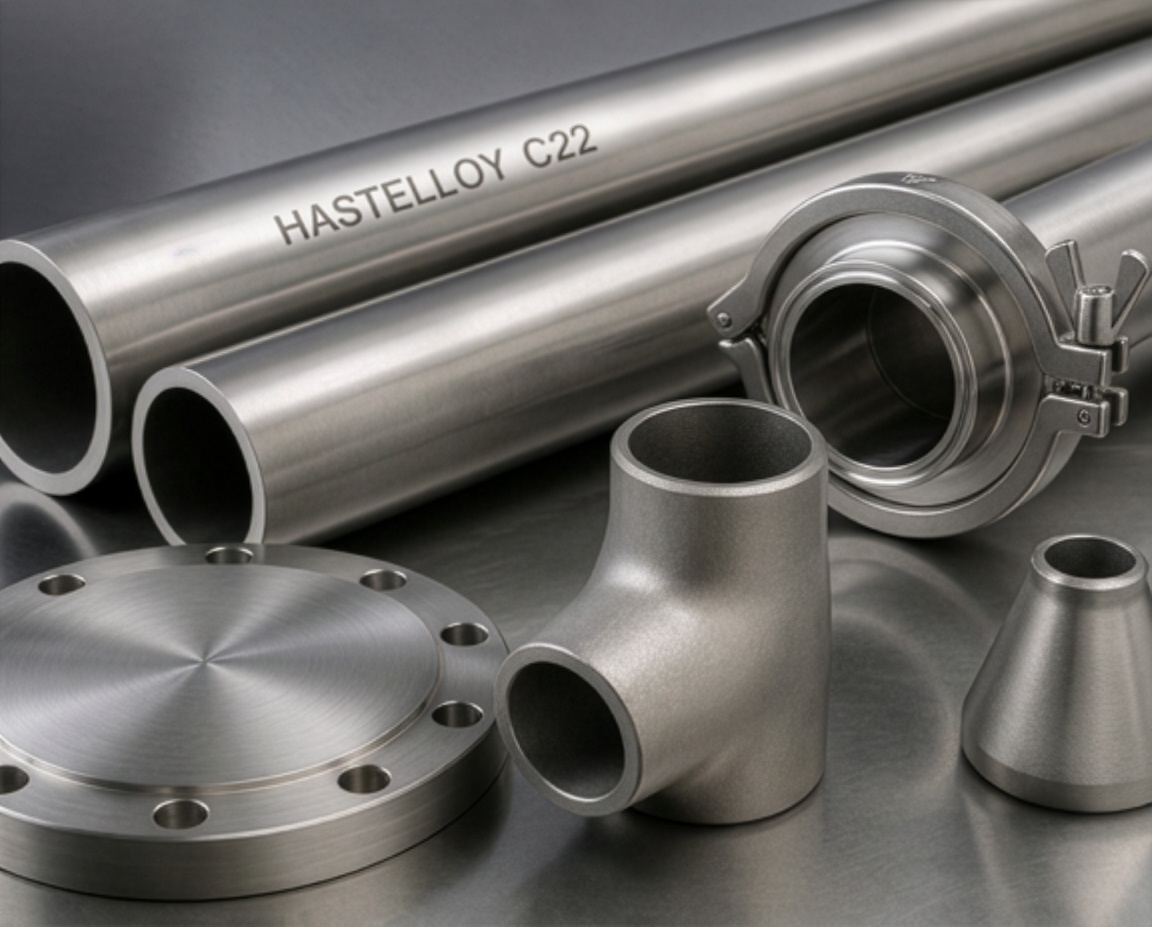
Hastelloy in sampling
What Hastelloy is
Hastelloy® is a registered trademark of Haynes International, Inc. and refers to a group of nickel-based alloys that are resistant to many aggressive chemicals. They all share a high nickel and molybdenum content; the individual groups differ significantly in composition and application focus.
- Hastelloy C – Nickel-chromium-molybdenum alloys with excellent resistance in oxidizing and reducing environments, even at elevated temperatures. The most commonly used group in process engineering.
- Hastelloy B – Highly corrosion-resistant nickel-molybdenum alloys with around 26 to 30% molybdenum. Peak performance in reducing environments, especially with hydrochloric acid.
- Hastelloy G – Particularly resistant to phosphoric acid (G-30) and thus typical for fertilizer plants.
- Hastelloy X – Alloy of nickel, molybdenum, chromium, and iron, extremely heat-resistant. Used in melting furnaces, industrial furnaces, and gas turbines.
The relevant alloys at a glance
- C-276 (Material No. 2.4819, UNS N10276) – the most commonly used alloy. Very high resistance to pitting, crevice, and stress corrosion cracking, resistant under both oxidizing and reducing conditions. Proven in hot contaminated mineral acids, organic acids, seawater, as well as moist chlorine and hypochlorite.
- C-22 (Material No. 2.4602, UNS N06022) – superior in oxidizing media due to the higher chromium content. Very versatile in use.
- B-2 / B-3 (Material No. 2.4617 / 2.4600) – the choice for reducing hydrochloric acid. Important: In oxidizing media – such as with iron(III) or copper(II) ions or nitric acid – B-alloys are expressly not suitable.
- G-30 (Material No. 2.4603) – designed for phosphoric acid and thus for fertilizer production.
- X (Material No. 2.4665) – for high-temperature applications, relevant in sampling with hot process gases.
This differentiation is not a detail for materials engineers. It is the difference between a sampler that runs for ten years and one that is replaced after two years.
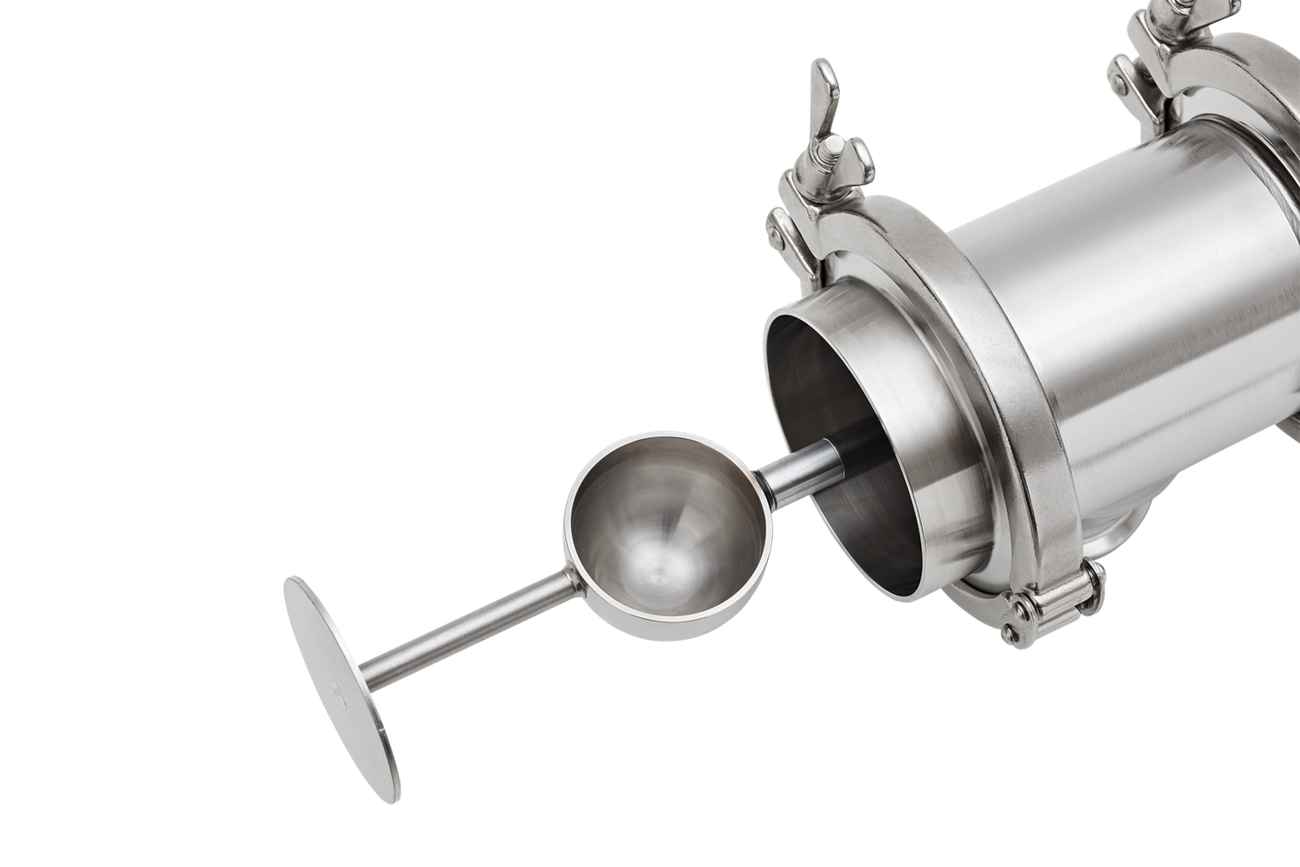
SAMglide by REMBE® Kersting
Why corrosion in sampling is more than a wear issue
Corrosion on a pipeline component means material loss. On a sampler, it also means a measurement error. Four effects typically occur:
- Contamination of the sample: Material removal products enter the sample. In trace analysis, this distorts exactly the values for which sampling is done.
- Changed surfaces: Roughened inner surfaces promote adhesions. The result is carryover between successive samples and a gradually decreasing representativeness.
- Crevice corrosion on sealing and guiding surfaces: Where dimensional accuracy is lost, tightness is also lost. In closed, inerted, or ATEX-relevant systems, this is immediately safety-relevant.
- Unplanned downtime: The sampler is located in the process line. Its failure is rarely just its own.
When stainless steel is sufficient – and when it is not
The vast majority of all sampling points are correctly and economically designed with stainless steel. Materials such as 1.4404 or 1.4571 reliably cover bulk goods, food, plastics, and many chemical applications. Switching to a nickel-based alloy is advisable if at least one of these points applies:
- reducing acids in the process, especially hydrochloric and sulfuric acid
- chloride-containing media with a risk of pitting, crevice, or stress corrosion cracking
- phosphoric acid, for example in fertilizer production
- hot, contaminated mineral acids, moist chlorine, or hypochlorite
- elevated temperatures in a corrosive atmosphere
- aggressive cleaning or sterilization media that are often overlooked in operation
Equally important is the reverse: Where stainless steel is sufficient, Hastelloy is the wrong investment. A serious design states both.
How REMBE® Kersting uses Hastelloy
At REMBE® Kersting, material selection is part of the plant design, not an option in the order form. Before construction, we clarify the medium and concentration, operating temperature, impurities – especially chlorides –, the cleaning media used, and the number of sampling cycles.
From this information, a purely Hastelloy machine is usually not created, but rather a deliberately mixed construction: The components in contact with the media are made in the appropriate nickel-based alloy, while the supporting structure, housing, and drive remain in stainless steel. This creates durability where it is needed without unnecessarily increasing the investment.
This mixed construction is the challenging part. It requires the right welding filler materials, a design that avoids gaps and deposit zones, and consideration of contact corrosion at the transitions between different materials.
Additionally, there is the manufacturing framework: Hastelloy tends to work harden and is significantly more challenging to machine than stainless steel: different cutting values, different tools, shorter tool life, longer processing times. When welding, the appropriate filler material determines whether the seam remains as durable as the base material. These requirements must be considered in the design and specification, not just in the workshop.
We do not manufacture the Hastelloy components in-house. They are produced according to our design and specification by qualified partners and are assembled into the sampling system at our facility. Individual Hastelloy components are also available upon customer request. Our contribution lies where decisions are made: in material selection, corrosion-appropriate design, specification to the manufacturer, and documentation.
Upon request, the systems are individually designed according to customer requirements, tailored to the material, process, and structural conditions on site.
Verifiable instead of claimed: Material certificates according to EN 10204
A material decision is only as valuable as its proof. Therefore, for all components in contact with media, we provide material certificates according to EN 10204. For customers who require proof, the inspection certificate 3.1 is our standard.
The difference is relevant: A certificate 3.1 documents test results on the actually delivered product and is confirmed by an inspection representative of the manufacturer who is independent of the production area. In contrast, a factory certificate 2.1 or a factory test report 2.2 does not provide product-specific testing.
The completeness of the proof chain is important to us. It does not end with the sampler:
- Sampler and all components in contact with media
- Measuring technology with material contact
- Accessories such as bottle adapters, bag holders, or transport tubes
Accessories, in particular, are often overlooked in tenders and qualifications. However, they come into contact with the product just like the sampler itself and therefore belong in the same documentation. Where traceability is required, this is a checkpoint and not an additional request.
The honest side: Limits and costs
Nickel-based alloys are significantly more expensive than stainless steel, sometimes associated with longer delivery times for the procurement of semi-finished products, and more complex to process. And they are not a universal material: A B-alloy that excels in hydrochloric acid fails in oxidizing media.
Therefore, from our perspective, there is no blanket answer "Hastelloy". The question is which medium encounters which components under what conditions – and from this, a justified material decision is derived.
Conclusion: Material competence is sampling competence
A sampler is not a plant component like any other. It is the first step in the measurement chain. Its material partly determines how resilient everything that happens afterward in the laboratory is.
Anyone who designs sampling systems for the chemical, fertilizer industry, or other demanding processes must master materials as confidently as mechanics, automation, and explosion protection – and be able to document the selection down to the last accessory. At REMBE® Kersting, this goes hand in hand.
Which media run through your sampling point – and in what material is it currently executed?
If you are unsure whether the current design fits your process, we will look at it together.