Cyclone
A cyclone, also known as a cyclone separator in this context, is a device used to separate particles from an air, gas or liquid stream without the use of a filter medium. Cyclones use the inertia of the particles and centrifugal forces to achieve separation.
In the context of bulk material sampling, a cyclone is often used to collect material samples from an air stream, especially in systems that use pneumatic conveying methods. Here, the bulk material is passed through a pipe and the cyclone is used to collect a material sample from this air flow.
In detail, a cyclone works as follows:
- The airflow containing the bulk material is introduced into the cyclone, usually in a tangential direction to the cyclone body, creating a spiral movement inside.
- Centrifugal force pushes the heavier particles (the bulk material) against the wall of the cyclone and then falls down into a collection container due to gravity.
- The purified air flow, now largely free of bulk material, leaves the cyclone through an opening at the tip, the so-called "cyclone outlet".
Cyclones can be used in many industries, especially where large quantities of bulk material are handled, such as food processing, the chemical industry, mining or power plants.
Interesting REMBE® Kersting solutions on this topic
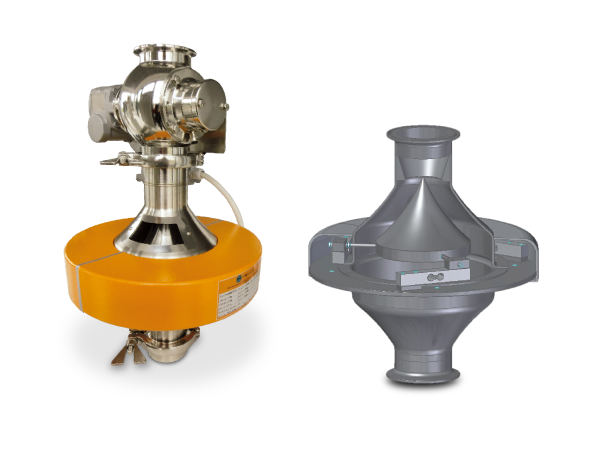
Flow metering VASOMETER®
The innovative measurement system for the flow of free-falling bulk materials
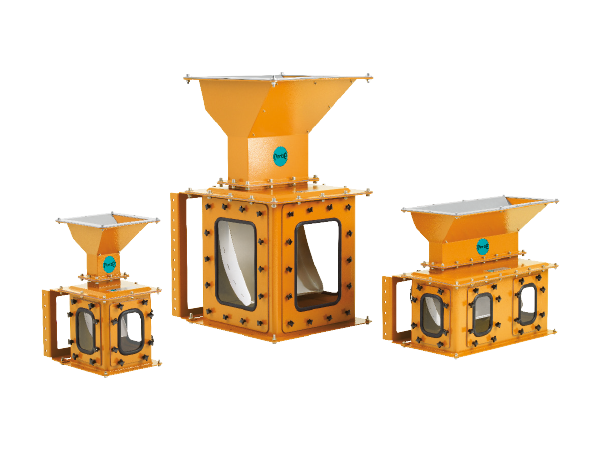
Flow metering C-LEVER®
The C-LEVER® ensures precise mass measurement of powders and bulk materials. Mass flow measurement technology for free-flowing bulk materials that can adapt to a wide range of process conditions