
Sample Carousel SAMbutler MIDI: How does automatic retention sample archiving work?
Why Retention Samples are So Important
In the food, feed, and pharmaceutical industries, retaining samples is not an optional extra. It is legally required and often part of certification requirements such as IFS, BRC, GMP, and HACCP. Retention samples are the last safeguard: If a quality problem arises later, it must be possible to prove what the material was like at the time of production.
In practice, retention samples are often still taken, labeled, and archived manually. This is time-consuming, prone to errors, and simply not feasible with the required consistency in high-throughput production processes. This is exactly where the SAMbutler MIDI comes in.
“Sampling and retention seamlessly, fully automatically, and in compliance with standards — without an employee leaving or intervening in the system.”
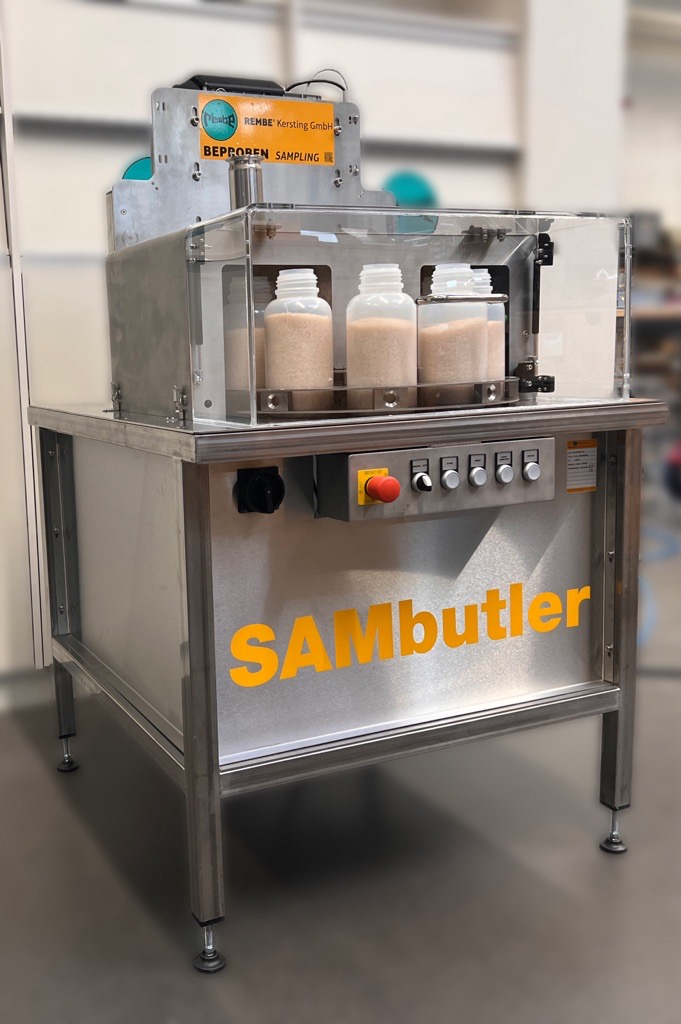
What is the SAMbutler MIDI?
The SAMbutler MIDI is a fully automatic sample carousel www.rembe-kersting.com/de/beproben/details/probenkarussell-sambutler-midi, which is directly integrated into existing production processes. It takes over the entire workflow of retention sample archiving: from sampling to transport and filling to labeling and magazine management.
The system consists of several coordinated components that work together:
Automatic sample transport via Venturi nozzle and stainless steel pipe
The carousel magazine with up to 20 sample containers
Automatic filling, closure control, and labeling
Control and sensors for seamless monitoring
The special feature: The entire system is designed to be used in ATEX zones (Zone 21 and Zone 22). A significant advantage for dust explosion-prone production areas in the food, feed, or chemical industry.
This is how the SAMbutler MIDI works: Step by step
The entire process runs fully automatically and can be individually configured on the integrated touch display. A typical example from practice: every five minutes, 80 ml of sample is taken. This results in six samples per 30-minute interval and a composite sample of 480 ml.
1. Sampling from the process
A sampler — e.g., a screw or cup sampler — takes the sample directly from the ongoing process: from a storage container, a conveyor line, or a mixer. The sampling is done inline, without interrupting the process. The sample quantity is infinitely adjustable.
2. Automatic transport
The sample is automatically transported from the sampling point to the sample carousel via product-friendly stainless steel pipes and bends using a Venturi nozzle. Even greater distances within the plant are no problem. Cross or residual contamination is excluded by the closed system.
3. Carousel opens the next bottle
Upon arrival at the SAMbutler MIDI, the system recognizes the current position in the carousel magazine. The mechanism automatically opens the next sample bottle (e.g., made of plastic or engraved stainless steel) and positions it precisely under the inlet.
4. Filling with quantity monitoring
The sample is filled into the bottle. Sensors continuously monitor the fill level and immediately detect if the defined quantity has been reached. Deviations are detected and reported. Misprocessing without detection is systemically excluded.
5. Sealing and labeling
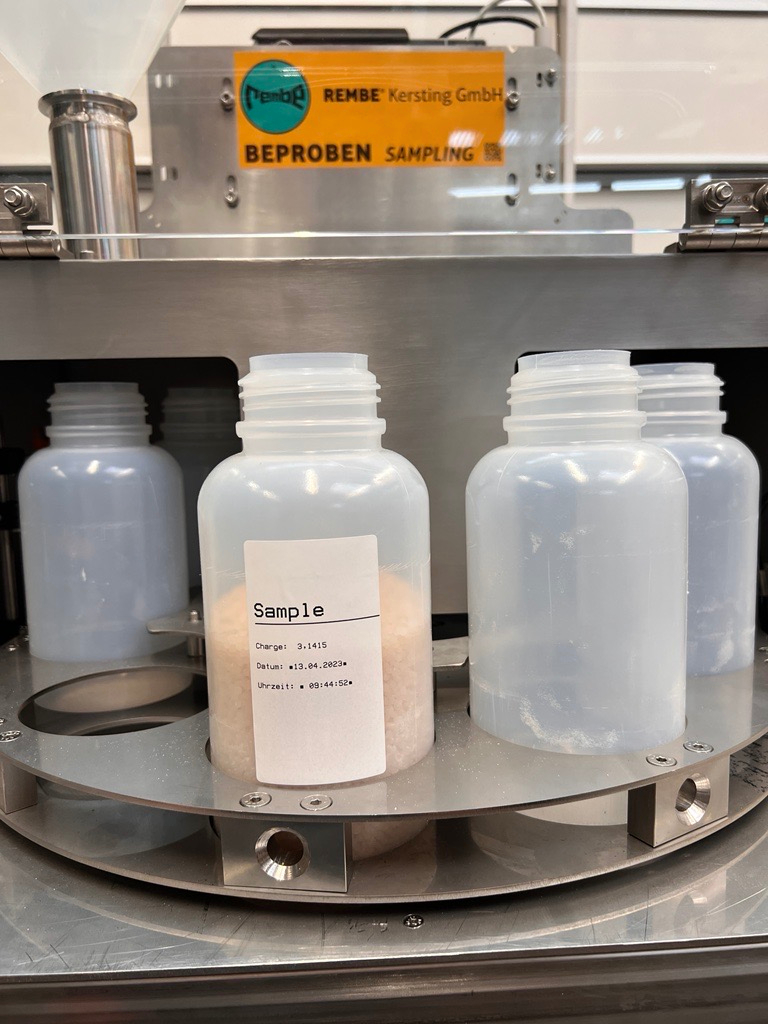
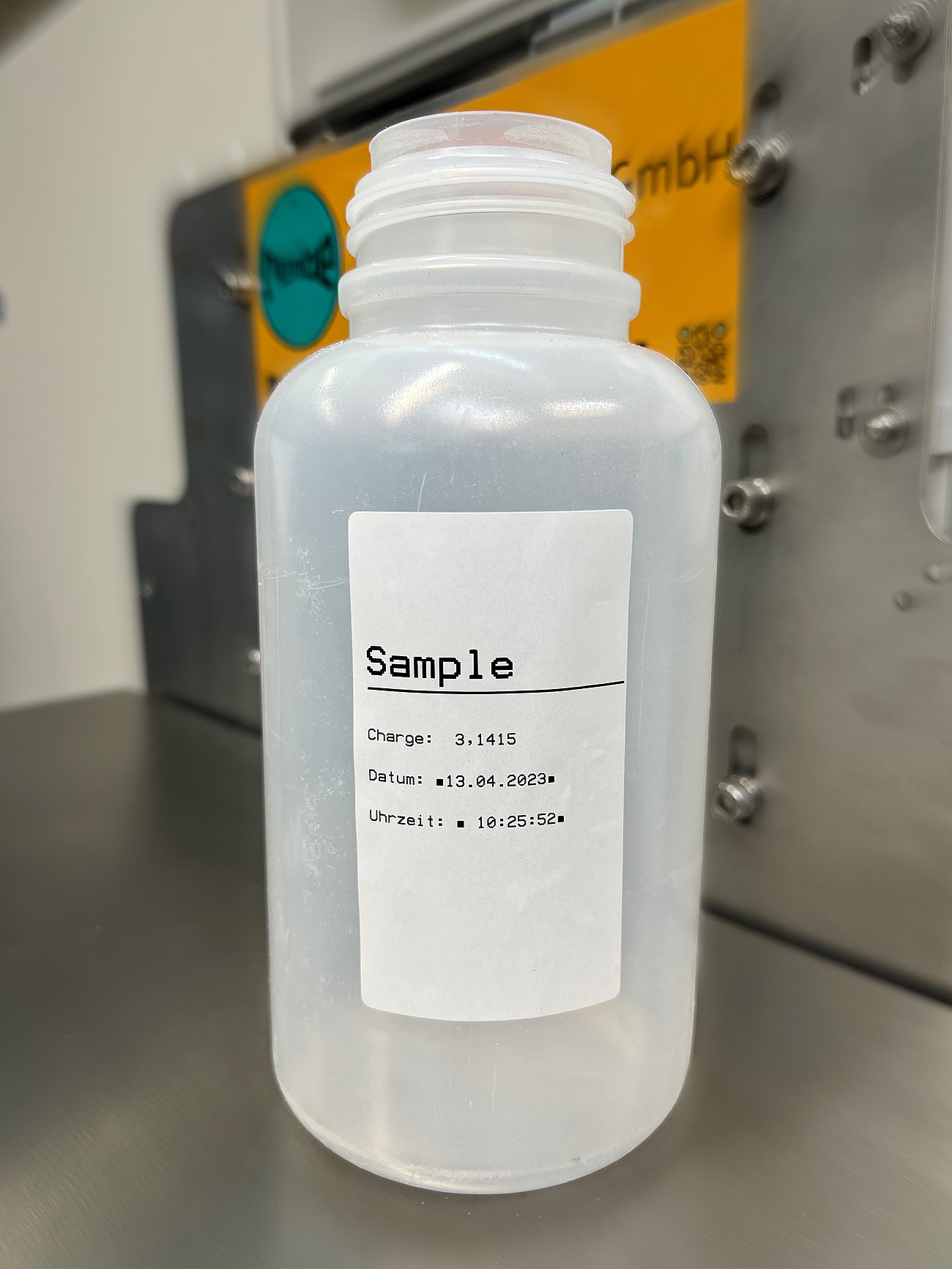
After filling, the system automatically seals the bottle. Subsequently, a label with all relevant information such as date, time, batch, and other configurable details is printed and applied to the bottle. The link between the sample and the production process is thus seamlessly documented.
6. Magazine and data transfer
The finished, labeled sample is archived in the carousel magazine. The magazine holds up to 20 bottles of 0.5 liters each and can be operated for up to ten hours without manual intervention. At the same time, the system automatically transfers all sample data (barcode, date, time, batch) to the higher-level control system, for example as an Excel list or via interface to the ERP/LIMS.
Full Transparency: Status Reports and Data Output
The SAMbutler MIDI is not just a mechanical system. It is also a monitoring system. The integrated sensors continuously report the status of all relevant components:
Fill level of the bottle magazine (when does it need to be refilled?)
Status of the labels (sufficiently available?)
Lifebit signal (is the system active and okay?)
Error messages for deviations in the process flow
The data transfer to the control system enables complete digital traceability: Each sample is uniquely linked to the associated production batch via its barcode. This creates the basis for GMP-, IFS-, and BRC-compliant documentation.
Your advantages at a glance:
- Fully automatic — no manual intervention required
- ATEX-compliant for Zone 21 and Zone 22
- GMP-, IFS-, BRC-, and HACCP-compliant retention sample documentation
- Magazine for up to 20 bottles — up to 10 hours of maintenance-free operation
- Seamless digital traceability via barcode and control system interface
- Sensor monitoring of every process step — misprocessing without detection is excluded
- Configurable sampling cycles and quantities on the touch display
- Use in food, feed, pharmaceuticals, chemicals, and battery production
Practical example: Automated sampling in a mill (Freiburg)
A vivid example shows how the SAMbutler MIDI is used in a real industrial plant: In a milling operation with an ATEX Zone 21 environment, a fully automated sampling and retention sample archiving was implemented.
Initial Situation
A representative sample is to be continuously taken from a template container and archived as a retention sample: fully automatic, GMP-compliant, and without manual intervention, even in the explosion-hazardous area.
Solution
SmartGlide Midi GMP: Sampler directly at the template container, cup volume 65 ml, with 4 limit switches and 3 cleaning nozzles
Automatic sample transport via Venturi nozzle and stainless steel pipe (ATEX Zone 21)
SAMbutler MIDI: Carousel with 12 engraved stainless steel bottles of 1.5 l each, fully automatic filling
ATEX label printer: Barcode labeling of all sample bottles
Interface to the control system: automatic Excel list with barcode, date, time, and batch
Result
Automated sampling of 800 g per hour, optionally in two automatic or one manual mode. All samples are seamlessly assigned to the respective production batch. The system operates in the ATEX Zone 21 area without adjustment of protective clothing or process interruption.
“The result is a complete, standard-compliant retention sample archiving, without personnel effort, without sources of error, without process interruption.”
For whom is the SAMbutler MIDI suitable?
The system can be used across industries, wherever retention samples or documented samples play a role:
Food and feed industry: IFS, BRC, HACCP-compliant documentation
Pharmaceuticals and fine chemicals: GMP-compliant retention samples, audit trail
Chemical industry: Sampling from dust explosion hazardous areas (ATEX)
Mineral and agricultural industry: Continuous quality assurance with large throughputs
Battery production: Sampling of cathode materials (NMC, LFP) under containment conditions
Whether bulk goods, granulates, or powders: the SAMbutler MIDI is designed for a wide range of materials and can be individually adapted to the respective requirements.
Integration without major renovation.
A common obstacle in the introduction of automated systems is the concern about extensive conversion measures. The SAMbutler MIDI is designed to be integrated into existing systems without significantly interrupting ongoing operations.
REMBE® Kersting takes care of planning, assembly, commissioning, and calibration from a single source. The in-house service is available worldwide and also includes recurring maintenance and telephone support.
Conclusion: Sample archiving that really works
The sample carousel SAMbutler MIDI turns an often neglected mandatory process into a reliable, automated quality component. It saves time, eliminates sources of error, and creates the seamless documentation that modern certification requirements demand.
The question is no longer whether one should automate the archiving of retention samples, but how quickly the transition makes sense.