Homogeneity testing of bulk materials and mixtures
Whether a mixing process really delivers a uniform product is not determined by the recipe, but by the homogeneity of the finished batch. Even with the correct formulation, bulk materials can remain inhomogeneous or segregate again after mixing—due to different particle sizes, densities, or moisture levels. If the mixing quality is not reliably tested, dosing errors, uneven distribution of active ingredients, and non-compliant batches may occur. A meaningful test requires mixing samples from several locations in the mixer, ideally from the ongoing process. This overview shows how homogeneity can be objectively demonstrated—from the requirements and sampling strategy to the selection criteria.
Selection criteria
Whether a homogeneity test is reliable depends less on the measuring device than on the sampling. These criteria are decisive:
-
Representative Sampling
The sample must be taken directly from the mixing volume, not just from the discharged material. Only then can local segregation be detected.
-
Multi-Point and Time-Series Sampling
Samples taken at multiple locations and at different times reveal whether mixing quality remains consistent throughout the entire batch.
-
In-Process Sampling
Sampling during the running process significantly shortens the feedback loop compared to downstream laboratory testing.
-
Dead-Space-Free Design
Flush-mounted systems that prevent material accumulation eliminate carryover between batches – essential for hygiene-sensitive applications.
-
Cleanability
CIP capability or tool-free disassembly ensures fast, verifiable product changeovers.
-
System Integration
Interfaces with process control and MES systems enable documented batch release.
Solution approaches
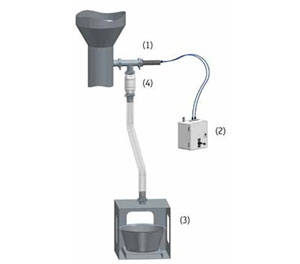
For homogeneity testing, the approaches range from manual sampling to sample dividers and up to automated samplers integrated into the mixer. Manual sampling at the discharge only reveals late whether a batch is inhomogeneous; sample dividers improve the preparation of the sample but do not solve the problem of the sampling location. Systems that take samples from the mixing volume during the ongoing process, on the other hand, significantly shorten the control loop. Which approach is suitable depends on the mixer type, bulk material characteristics, and the required degree of automation.
The approach of REMBE® Kersting
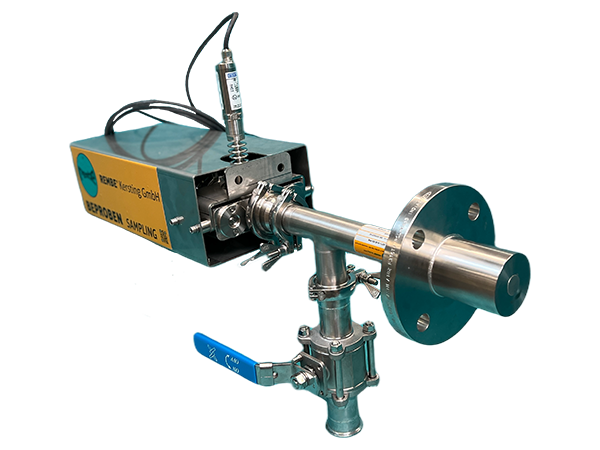
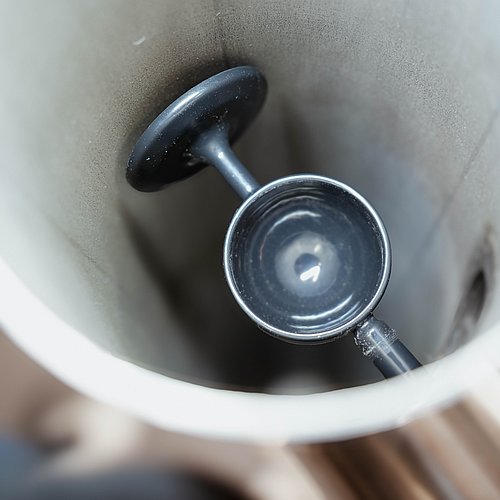
For process-oriented homogeneity testing, REMBE® Kersting relies on SAMscrewtasty for sampling directly from the mixing chamber—flush with the wall, so that the system can also be used with mixers featuring agitators close to the wall. Because the sample is taken from the mixing volume itself, local segregation becomes visible, which would not be detected by a sample taken from the discharged material. The flush-mounted design also avoids dead spaces where product can accumulate and be carried over between batches.
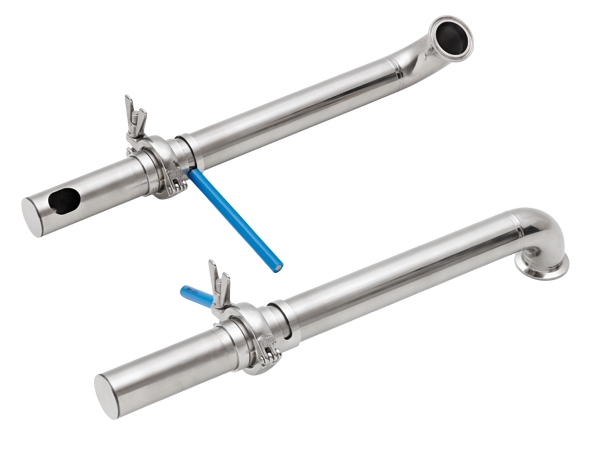
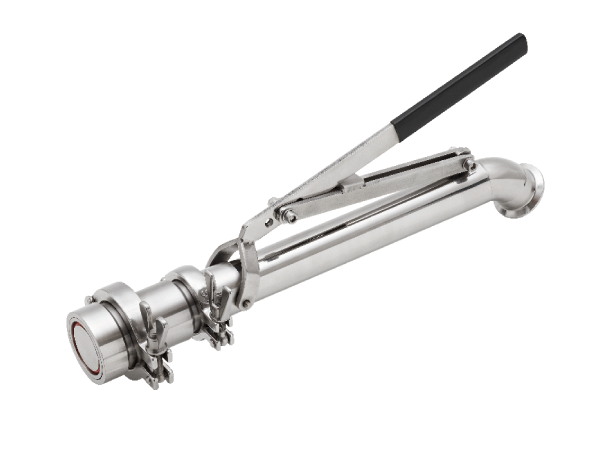
Additionally, the sampling nozzle SAMtasty allows for representative sampling at defined process points outside the mixer. Which combination is appropriate depends on the mixer type, agitator geometry, and cleaning requirements.
For in-process mixing quality testing, this results in reproducible, dead-space-free sampling from the ongoing mixing process—the basis for reliable homogeneity assessment.